
What if the "lack of motivation" or "rebellion" you are seeing in your teen is actually a quiet signal that their brain simply processes information differently? You've likely spent many nights worrying as you watch your bright, capable child lose their confidence because school feels like an impossible climb. It's painful to see them struggle with undiagnosed learning hurdles, especially when you're unsure if a psychoeducational assessment will provide a solution or just another label. You deserve to know why your teen is struggling, and more importantly, you deserve to see them shine again.
We understand the confusion that comes with choosing between school-based and private testing here in Alberta. This guide will help you find a clear roadmap for your teen's education by discovering how a comprehensive evaluation can unlock their hidden potential and validate their unique strengths. You'll learn how to move from a place of worry to a place of action, with specific strategies for teachers and home life that foster resilience. If you're ready to start this journey, our specialized psychologist team is here to walk with you every step of the way as we turn these challenges into a personalized plan for your family's growth and flourishing.
Key Takeaways
- Understand why pursuing a psychoeducational assessment is a courageous step of advocacy that validates your teen's experience and uncovers their unique learning profile.
- Gain clarity on the testing journey so you can reassure your teen about what to expect during their comfortable, one-on-one evaluation sessions.
- Transform your perspective by focusing on your teen's cognitive strengths rather than just their struggles, creating a foundation for lasting confidence.
- Learn how to secure actionable classroom supports, like extra time or specialized technology, that allow your teen's true potential to shine through.
- Discover practical ways to navigate insurance and find a specialized team in Alberta that treats your family as partners in your child's growth.
Understanding Your Teen’s Struggle: What is a Psychoeducational Assessment?
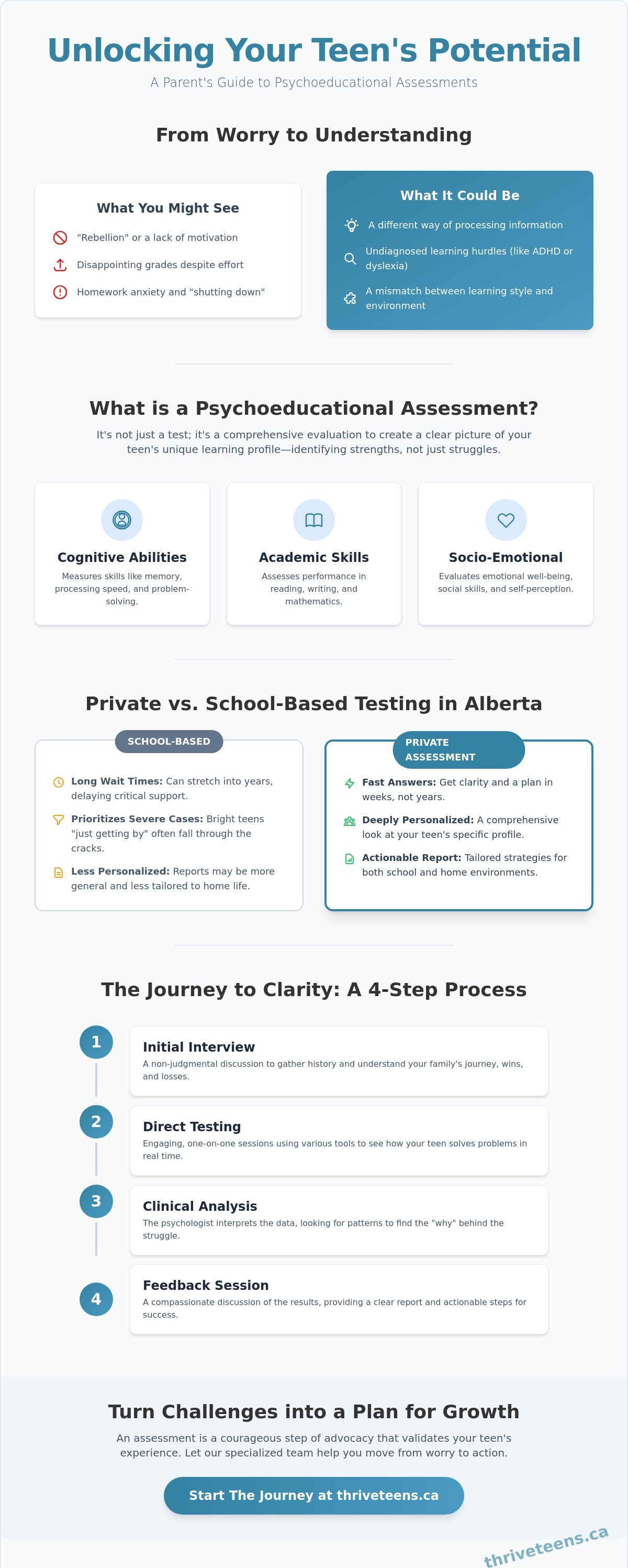
Watching your teen slowly withdraw or lose their spark is heartbreaking. You see their potential, but somehow, it isn't translating to the classroom. Choosing to seek a psychoeducational assessment isn't a sign that you've failed as a parent; it is one of the most powerful acts of advocacy you can perform. It's a shift from guessing why they are struggling to finally understanding how their unique brain is wired. This process is a comprehensive evaluation that looks at cognitive abilities, academic skills, and socio-emotional functioning to create a clear picture of your teen’s world.
To understand the broader context of these evaluations, it helps to look at what is an educational assessment and how it serves as a foundation for supporting student growth. By identifying a specific "learning profile" rather than just a "label," we can pinpoint exactly where the hurdles are. Whether your teen is navigating ADHD, dyslexia, or the unique challenges of giftedness, this assessment provides the clarity needed to replace frustration with a plan for success.
To better understand this concept, watch this helpful video:
Signs Your Teen Might Benefit from a Professional Evaluation
You might notice your teen "shutting down" when it's time for homework, or perhaps they are putting in hours of effort only to receive disappointing grades. This discrepancy between their obvious intelligence and their actual output is a major red flag. Sometimes, the struggle shows up as school-related anxiety or even teen self-harm tendencies when they feel they can't meet expectations. If your teen seems persistently frustrated despite their best efforts, it's a sign that their current environment might not match their learning needs.
Private Assessments vs. School-Based Testing in Alberta
In Edmonton and across Alberta, school boards provide testing, but the wait times can often stretch into years. These boards must prioritize the most severe cases, which means many bright teens who are "just getting by" fall through the cracks. Choosing a private psychological assessment allows for a much deeper, more personalized level of attention. You get answers in weeks, not years, and the resulting report is tailored specifically to your teen’s life, both at school and at home.
The Journey to Clarity: What to Expect During the Assessment Process
It is completely natural to feel a sense of "scanxiety" when you aren’t sure what a clinical evaluation looks like for your child. We want this to be a steady, supportive experience for both you and your teen. A psychoeducational assessment is not a single test. It's a comprehensive story of how your teen learns. For more context on the legal and educational framework of these evaluations, you can view this guide to the assessment process. The journey typically follows four clear steps:
- The Initial Interview: We begin by gathering history from you and your teen in a non-judgmental space. We want to hear about the wins, the losses, and the moments that led you here.
- Direct Testing: This involves engaging, one-on-one sessions. We use various tools to measure memory, processing speed, and academic skills. It’s about seeing how they solve problems in real time.
- Clinical Analysis: Your psychologist spends several hours interpreting the data. They look for patterns to find the "why" behind the struggle.
- The Feedback Session: We meet for a compassionate discussion about the results. We don't just hand over a report; we provide a roadmap of practical next steps.
Preparing Your Teen for the Assessment Day
If your teen is nervous, try using a simple script to lower their defenses. You might say: "We're going to spend some time with a specialist to look at how your brain works. It’s like doing some brain puzzles to find out where you’re a total pro and where we can find some shortcuts to make school less of a grind." Ensure they get plenty of rest and a stress-free morning before visiting our Edmonton or Sherwood Park clinics. A calm start helps them perform at their best.
The Role of the Registered Psychologist
In Alberta, only a Registered Psychologist or Registered Provisional Psychologist has the specialized training to perform these evaluations. Our team focuses on building genuine rapport first. We want your teen to feel safe and seen before we ever open a testing kit. If you have questions about which specialist is the best fit for your family, feel free to browse our team of dedicated advocates.
Beyond the Results: How an Assessment Transforms Your Teen’s Education
Imagine the weight lifting off your teen’s shoulders when they finally realize they aren’t "lazy" or "slow." For many families, the most profound outcome of a psychoeducational assessment is this fundamental shift in identity. Instead of focusing on perceived deficits, we begin to build a strengths-based understanding of how their brain works. This clarity allows us to move away from shame and toward a strategy that celebrates their unique cognitive profile. It turns a daily struggle into a manageable plan for success.
The data we gather identifies specific accommodations that can immediately change your teen’s school experience. These might include extra time on exams, the use of assistive technology, or access to quiet testing spaces to reduce sensory overwhelm. If you have been wondering how to get tested for ADHD, this comprehensive evaluation is the gold standard for identifying executive dysfunction. It provides the clinical proof needed to show that your teen is working incredibly hard, but they simply need a different set of tools to reach their full potential.
Navigating the Individual Support Plan (ISP) in Alberta Schools
In our local education system, an individual support plan is the essential document that unlocks consistent help. Your teen’s assessment report serves as the formal clinical evidence Alberta schools require to implement these supports. It bridges the gap between a student’s internal needs and the school’s external resources. This ensures that every teacher has a clear, professional guide on how to support your child’s specific way of learning, regardless of the subject.
Support for Neurodivergent Teens: ADHD and Giftedness
Some students are "twice-exceptional" or 2e. This means they are highly gifted but also live with a learning disability or ADHD. These teens often feel the most misunderstood because their high intelligence can mask their underlying struggles, leading to burnout. Our specialized teen therapy in Alberta helps address the emotional side of neurodivergence, building the self-esteem needed to flourish. If you are ready to give your teen the tools they deserve, book a psychoeducational assessment consultation to start their journey toward clarity.
Taking the Next Step: Finding the Right Assessment Team in Alberta
You've likely spent months wondering if there was something more you could do to support your child. It's a heavy burden to carry alone. If your intuition is telling you that your teen needs more help than they're currently receiving, trust that feeling. Choosing a psychoeducational assessment is the first step toward a lighter future. At Thrive Teen Therapy Alberta, we're a community of dedicated advocates who specialize exclusively in the unique world of youth and young adults. We aren't just a cold medical clinic; we're a steady hand for families looking for real resolution.
We know that the logistics of seeking help can feel daunting. To help you move forward effectively, we suggest these practical steps:
- Review your health benefits: Most private insurance plans in Alberta provide coverage for psychological services. You can also claim non-reimbursed fees as a medical expense on your income tax returns.
- Explore accessible options: For families facing financial barriers, we provide reduced rate options because we believe every teen deserves to be understood.
- Plan for follow-up care: A diagnosis is just the beginning. Transitioning into therapy helps your teen integrate this new information, turning a "label" into a source of personal empowerment.
A psychoeducational assessment provides the roadmap, but the journey toward flourishing continues long after the report is written. Our psychologists remain your partners, helping you navigate the emotional side of neurodivergence and ensuring your teen feels capable of tackling their next big milestone with confidence.
Specialized Support in Edmonton, Sherwood Park, and Beyond
Our commitment to your family often extends beyond the assessment room. We provide child psychology services for younger siblings and young adult therapy for those preparing for the transition to university. Whether you're looking for local support or a specialized perspective, our team is ready to help. We invite you to meet our Sherwood Park therapists or connect with our Edmonton team to find the perfect ally for your family’s journey toward wellness.
Empowering Your Teen’s Future with Clarity and Support
Watching your teen navigate undiagnosed learning hurdles is a heavy experience for any parent. You've now seen how a psychoeducational assessment can transform that struggle into a strengths-based journey of self-discovery. By moving from a place of "guessing" to a place of "knowing," you're providing your child with the validation they deserve. This process isn't just about identifying challenges; it's about building a foundation where their unique brain can finally thrive in the classroom and beyond.
Our team of Registered Psychologists specializes in youth and neurodivergence, offering a compassionate, teen-first approach to every evaluation. We create comprehensive reports specifically tailored for Alberta school boards and Individual Support Plans, ensuring your teen gets the exact accommodations they need. You've already taken the first step by seeking information. Now, let’s take the next step together toward a future where your teen feels capable and confident. We invite you to book a consultation with our assessment team today. Your family’s path to growth and flourishing starts here.
Common Questions About the Assessment Journey
How long does a psychoeducational assessment take from start to finish?
The entire process typically takes four to six weeks from your initial interview to the final feedback meeting. This duration ensures our team has enough time to gather a thorough history, complete the one-on-one testing sessions, and perform a deep clinical analysis of the data. We recommend starting the psychoeducational assessment well in advance of major school transitions so your teen has their support plan ready when they need it most.
Can a psychoeducational assessment diagnose ADHD or Autism?
Yes, this evaluation is the primary tool for identifying ADHD, giftedness, and specific learning disabilities like dyslexia or dyscalculia. While it provides a comprehensive look at your teen's socio-emotional world and can identify indicators of neurodivergence, a specialized assessment is often required for a formal Autism diagnosis. Understanding these patterns helps replace your teen's frustration with a clear, validated sense of self and a roadmap for their growth.
What is the difference between a school psychologist and a private psychologist for assessments?
School-based psychologists often focus on whether a student qualifies for specific funding or classroom placements, while private psychologists provide a more holistic look at your teen's overall well-being. Private evaluations in Alberta typically offer much shorter wait times than the long lists often found within school boards. You also maintain full ownership of the final report, allowing you to share it with whichever doctors or post-secondary institutions you choose.
Will my teen be upset about being tested?
Most teens feel a sense of relief once they realize the testing isn't about finding out what's "wrong" with them but about making their lives easier. We prioritize building a genuine connection before any testing begins so your teen feels respected and safe. When they understand the results provide a way to stop the struggle at school, their initial nerves usually turn into a feeling of being finally understood.
How much does a private psychoeducational assessment cost in Alberta?
Costs for these evaluations vary across the province based on the complexity of the testing and the specific areas of concern being explored. Many families use their private insurance or employer health benefit plans to cover a portion of the fees for psychological services. Any remaining costs that aren't reimbursed can often be claimed as a medical expense on your annual income tax return, helping to make this vital support more accessible for your family.