
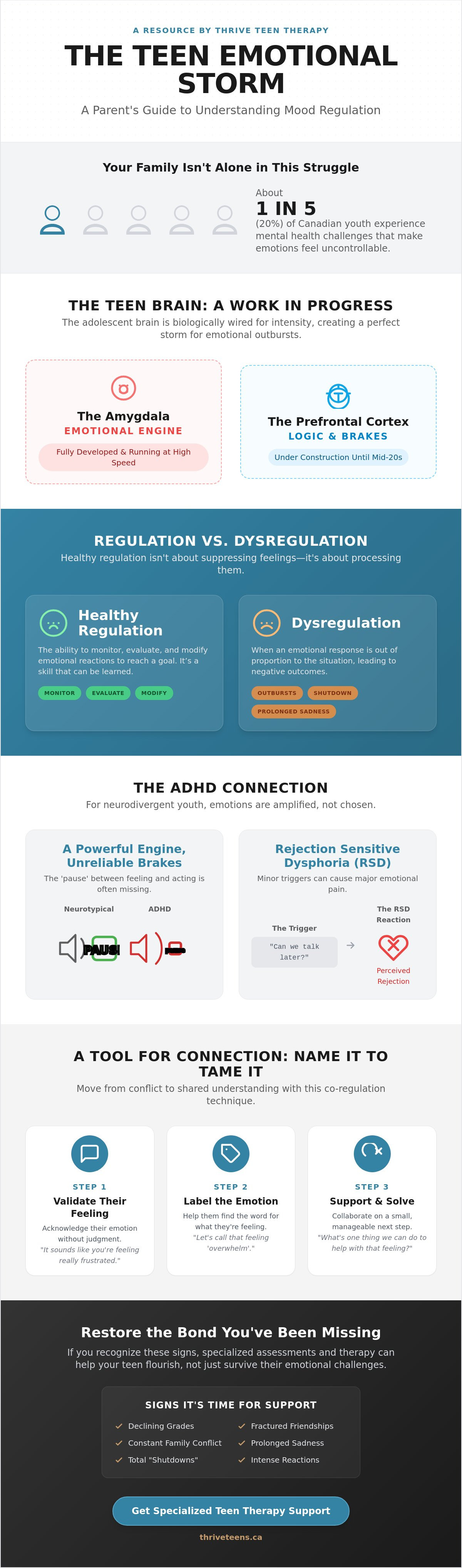
You ask a simple question about school, and suddenly, the kitchen feels like a pressure cooker about to blow. Maybe your teen slams a door, or perhaps they retreat into a heavy, unreachable silence that leaves you feeling like you're walking on eggshells in your own home. It's incredibly difficult to watch your child struggle with mood regulation, especially when you fear the close bond you once shared is starting to break. You aren't alone in this; about 20% of Canadian youth experience mental health challenges that can make emotions feel like an uncontrollable storm.
Sometimes, despite your best efforts and the most compassionate co-regulation, the emotional storm remains too intense to manage alone. It is painful to realize that your support might not be enough, but recognizing this is an act of profound love. Certain "red flags" suggest your teen needs a specialized space to work through their struggles. These include a sudden drop in school performance, withdrawal from long-time friends, or when difficulties with mood regulation begin to interfere with their ability to function in daily life. If your teen is frequently overwhelmed by their own internal world, professional intervention can provide the relief you both need. In addition to clinical care, you can discover more about High School Assemblies that help foster a supportive school environment where students can learn to navigate these emotional challenges with confidence.
We understand that you're looking for a way back to calm, and we agree that your family deserves a home environment defined by connection rather than correction. This guide provides compassionate, evidence-based strategies to help your teen manage their feelings with more confidence. We'll explore practical tools to use during an emotional crisis, the unique ways ADHD impacts teen emotions, and how to know if it's time to reach out for professional support from our team of registered psychologists in Alberta.
Key Takeaways
- Understand that mood regulation is a skill that can be nurtured, and learn why your teen’s developing brain often makes managing big feelings feel like an uphill battle.
- Uncover the link between ADHD and emotional dysregulation, including how Rejection Sensitive Dysphoria can trigger intense reactions you didn't see coming.
- Master the "Name It to Tame It" technique and other co-regulation tools that help you move from a place of conflict to one of shared understanding.
- Identify specific signs that it's time to seek outside help and how professional support can restore the parent-child bond you've been missing.
- Discover the benefits of specialized youth assessments and therapy to help your teen flourish rather than just survive their emotional challenges.
What is Mood Regulation and Why is it So Hard for Teens?
Watching your teen struggle with intense emotions can leave you feeling helpless and exhausted. It's completely normal to feel overwhelmed when your once-calm child suddenly reacts with explosive anger or retreats into a heavy silence. At its core, Emotional self-regulation is the ability to monitor, evaluate, and modify emotional reactions to reach a goal. It isn't about having a "good" or "bad" personality; it's a complex cognitive skill that takes time and practice to master.
Many parents mistakenly believe that mood regulation means their teen should just "stop" feeling a certain way. However, healthy regulation is the opposite of suppression. While suppression acts like a lid on a boiling pot, true regulation involves processing the heat so the pot doesn't boil over. To better understand how these micro-habits form, watch this helpful video:
The Difference Between Mood Regulation and Dysregulation
Dysregulation occurs when a teen's emotional response is out of proportion to the situation. You might see this as prolonged sadness, sudden outbursts, or a total "shut down" where they refuse to communicate. In 2026, studies show that stress management and relationship challenges are the top concerns for Albertans seeking support. For youth in Alberta, these emotional spikes often lead to declining grades or fractured friendships, making the need for teen therapy in Alberta more vital than ever.
Why the Teen Brain is Wired for Intensity
The adolescent brain is essentially a work in progress. The amygdala, which processes emotions, is fully developed and running at high speed, while the prefrontal cortex, the area responsible for logic and "putting on the brakes," won't be fully finished until their mid-twenties. This biological gap creates a perfect storm for emotional intensity. Fortunately, in 2026, we define neuroplasticity as the brain's ability to grow new emotional pathways and strengthen self-control through targeted therapeutic support.
The ADHD Connection: How Neurodivergence Impacts Emotional Flow
If you feel like your teen reacts to minor setbacks as if they were major catastrophes, you aren't imagining it. For neurodivergent youth, mood regulation isn't just a matter of willpower; it is deeply tied to how their brain processes information. When a teen has ADHD, the executive functions responsible for self-control often struggle to keep up with the speed of their emotions. This creates a "thin filter" where every feeling, whether it is joy or frustration, hits with 100% intensity.
One of the most painful aspects of this journey is Rejection Sensitive Dysphoria (RSD). This isn't just being sensitive. It's an overwhelming emotional pain triggered by the perception of being rejected, teased, or criticized. For a teen already navigating identity-based stress, such as those in the LGBTQ2S+ community or gifted students facing high expectations, RSD can make daily life feel like a minefield. To get to the bottom of these intense reactions, many families find that psychoeducational assessments provide the clarity needed to stop guessing and start supporting.
Executive Function and the Emotional 'Brake' System
Think of executive function as the brain's braking system. In a neurotypical brain, there is usually a split-second pause between feeling an emotion and acting on it. For teens with ADHD, that pause is often missing. This makes ADHD's impact on emotional flow feel like driving a car with a powerful engine but unreliable brakes. Our specialized teen ADHD support focuses on building these internal brakes through practical, skill-based coaching that respects their unique wiring.
The Role of Sensory Overload in Emotional Spikes
Sometimes, what looks like a mood swing is actually a sensory meltdown. Fluorescent lights in a classroom or the overlapping chatter of a busy lunchroom can overstimulate a neurodivergent nervous system. When the brain is busy managing too much sensory input, it has less energy left for mood regulation. You can help by identifying sensory triggers early. If you notice your teen becoming irritable in loud or crowded spaces, suggesting a quiet break can prevent an emotional spike before it begins. If you're seeing these patterns frequently, our Edmonton therapists can help your family develop a personalized plan to manage these daily stressors.
5 Practical Mood Regulation Techniques for Your Teen
When your teen is in the middle of an emotional storm, they often lose access to the logical part of their brain. This is where mood regulation becomes a shared journey. Effective support often starts with the adult in the room through a process called co-regulation. By staying calm and present, you act as an external nervous system for your teen, helping them slowly return to a state of safety. Your calm is a superpower; it provides the steady anchor they need when their own world feels chaotic.
Beyond your presence, there are several evidence-based tools you can teach your teen to use when they feel their emotions rising:
- Name It to Tame It: Encourage your teen to put a label on their feeling. Simply saying "I feel frustrated" or "I feel invisible" can reduce the intensity of the emotion by shifting activity from the emotional centre to the processing centre of the brain.
- The 5-4-3-2-1 Grounding Exercise: To stop an anxiety spiral, ask them to name 5 things they see, 4 things they can touch, 3 things they hear, 2 things they can smell, and 1 thing they can taste. This pulls their focus out of their head and back into the physical room.
- TIPP Skills: Borrowed from Dialectical Behaviour Therapy, TIPP stands for Temperature (splashing cold water on the face), Intense exercise (doing 20 jumping jacks), Paced breathing, and Paired muscle relaxation. These physical "hacks" quickly reset the nervous system.
The Power of Validation
Validation is the bridge to connection. Often, we want to fix the problem or tell our teens why they shouldn't feel a certain way, but this usually leads to more conflict. Try this 3-step script instead:
1. Observe: "I notice your shoulders are really tense and you're speaking more loudly."
2. Validate: "It makes sense that you're angry because that situation at school felt really unfair."
3. Offer Presence: "I'm right here with you. We don't have to fix it this second, but I'm not going anywhere."
Mindfulness and Physical Regulation
Physical movement is one of the fastest ways to process the adrenaline that comes with a mood spike. If your teen is open to it, suggest a "movement break" like a quick walk around the block or even just stretching. You can also practice box breathing together: inhale for 4 seconds, hold for 4, exhale for 4, and hold for 4. This simple rhythm tells the body it is no longer in danger. If these moments are happening more frequently, it may be helpful to speak with our Edmonton therapists to build a more robust toolkit for your family.
Finding Specialized Support: Teen Therapy in Edmonton
Sometimes, despite your best efforts and the most compassionate co-regulation, the emotional storm remains too intense to manage alone. It is painful to realize that your support might not be enough, but recognizing this is an act of profound love. Certain "red flags" suggest your teen needs a specialized space to work through their struggles. These include a sudden drop in school performance, withdrawal from long-time friends, or when difficulties with mood regulation begin to interfere with their ability to function in daily life. If your teen is frequently overwhelmed by their own internal world, professional intervention can provide the relief you both need.
Working with a registered provisional psychologist offers a unique benefit for families. These professionals have completed their Master's degrees and are in the process of finishing 1600 hours of supervised practice, often bringing fresh, evidence-based perspectives to mood disorders. Therapy isn't about "fixing" your child. It is about providing a safe, non-judgmental environment where they can build a personalized toolbox of skills. Whether you are in a major hub or a smaller community like Beaumont or Vegreville, virtual therapy has made this specialized support accessible to families across Alberta.
Choosing the Right Fit for Your Teen
The success of therapy often hinges on the "therapeutic alliance." This is the bond between the teen and their therapist. If your teen doesn't feel liked or understood, they are unlikely to open up. We encourage you to meet our Edmonton therapists to find a specialist who resonates with your teen’s personality and interests. When a teen feels they have a reliable ally, they become much more willing to engage in the hard work of emotional growth.
Taking the Next Step Together
Bringing up the idea of counselling can feel daunting. Try to frame it as a way to gain a "performance coach" for their brain rather than a sign that they are broken. You might say, "I can see how much you're hurting, and I want you to have a space that is just yours to talk about it." For more detailed advice on starting this journey, our Teen Therapy in Edmonton & Area: A Parent's Guide offers practical steps for navigating local support systems. You don't have to weather this storm alone; our team is here to partner with your family on the path toward holistic flourishing.
Empowering Your Family's Emotional Growth
The intense emotional waves of the teen years can feel like a constant battle, but these moments of struggle are also opportunities for deep connection. By shifting from correction to co-regulation, you provide the safety your teen needs to practice their own skills. Remember that mood regulation is a developmental milestone that takes time, patience, and often a little extra support to achieve. Whether your teen is navigating the complexities of ADHD or seeking a safe space for LGBTQ2S+ identity, specialized care can make the difference between surviving and flourishing.
Our clinical team of Registered Psychologists and Social Workers is here to help you navigate this journey. We offer in-person sessions in Edmonton and Sherwood Park, as well as virtual support across Alberta. You don't have to carry the weight of these emotional storms by yourself. Book a consultation with our specialized teen therapy team in Alberta today. Your family's path toward a calmer, more connected home starts with a single step, and we are ready to walk it with you.
Frequently Asked Questions
What is the difference between mood swings and emotional dysregulation?
Mood swings are a typical part of adolescent development, but emotional dysregulation involves reactions that are significantly out of proportion to the trigger. While a mood swing might pass quickly, dysregulation often feels like an "all or nothing" response that is difficult to recover from. You might notice your teen getting stuck in a high intensity state for hours rather than minutes, which often signals that they need more support to build their internal coping skills.
Can ADHD cause my teen to have trouble regulating their moods?
ADHD absolutely impacts a teen's ability to manage mood regulation because it affects the brain's executive functions. Since the prefrontal cortex acts as the brain's "brake system," a teen with ADHD often lacks the pause needed to process a feeling before acting on it. This results in emotions that feel much more intense and immediate than those of their neurotypical peers, often leading to sudden outbursts or deep frustration over minor setbacks.
How can I help my teen calm down during a meltdown without making it worse?
The most effective way to help is to focus on co-regulation by keeping your own nervous system calm and steady. Avoid trying to use logic or asking "why" during the peak of the storm, as the logical part of their brain is temporarily offline. Instead, offer a quiet presence, reduce sensory input like loud noises or bright lights, and wait until they have fully returned to a baseline of calm before discussing the situation or finding solutions.
When should I consider professional teen therapy for my child in Alberta?
You should consider professional support when emotional spikes begin to interfere with your teen's school performance, friendships, or your family's daily life. In Alberta, about 20% of youth experience mental health challenges, and seeking help early can prevent these patterns from becoming more deeply rooted. If you find yourself walking on eggshells at home or fear the parent child bond is breaking, it is a sign that your family could benefit from a specialized therapeutic approach.
Is mood regulation the same thing as self-control?
No, they are distinct concepts that serve different purposes in emotional health. Self-control is the ability to suppress an impulse or behavior, whereas mood regulation is the internal process of monitoring and modifying the emotional experience itself. Regulation is a complex skill that involves understanding the "why" behind a feeling and using tools to shift the internal state, rather than just forcing oneself to act a certain way to avoid consequences.