
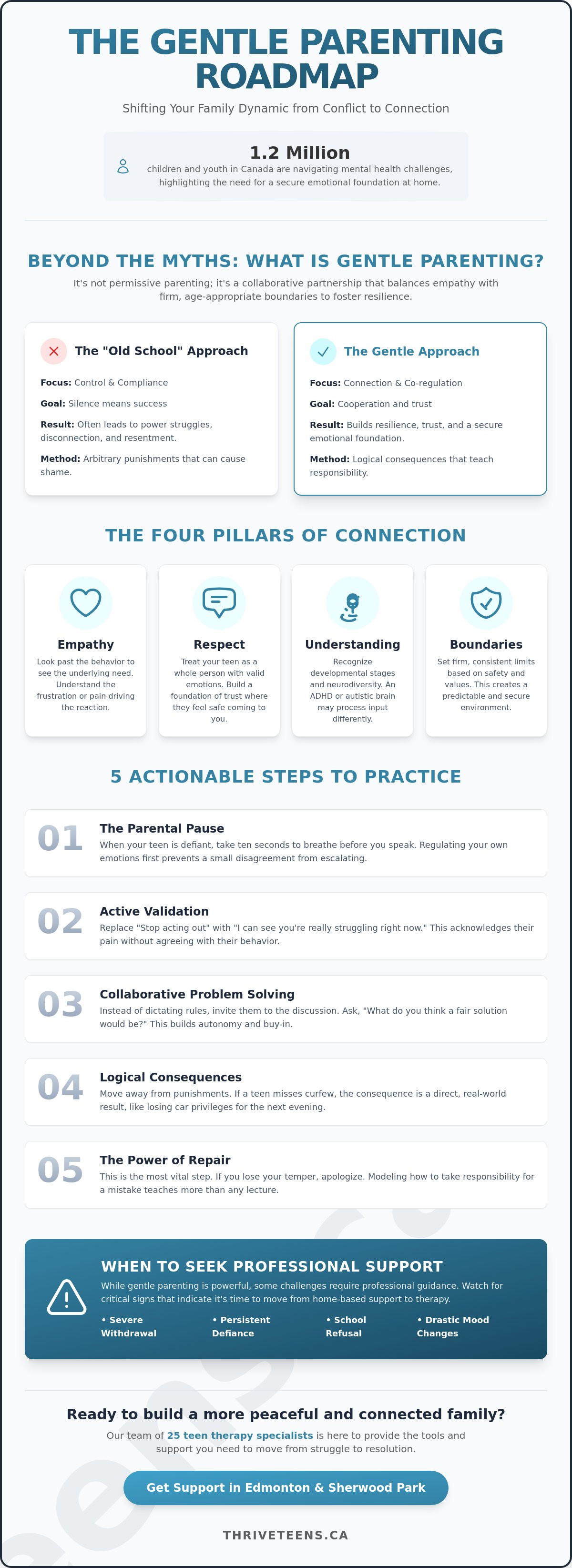
What if the moments your child is at their most difficult are actually the moments they need your connection the most? It is exhausting to feel like every evening in your Edmonton home is a battleground of power struggles and slammed doors. You likely feel like a "bad parent" when traditional discipline fails, yet many families find that gentle parenting offers the emotional bridge they have been searching for. According to a 2023 report from the Mental Health Commission of Canada, 1.2 million children and youth are currently navigating mental health challenges, which underscores the vital need for a secure emotional foundation at home.
By choosing this compassionate approach, you can shift your family dynamic from constant control to genuine cooperation. This guide provides a roadmap to help you foster deep connection and resilience in your children and teens across Sherwood Park. We will share practical tools for handling meltdowns and defiance, helping you build a peaceful environment where your children feel safe sharing their problems with you. Our team of 25 teen therapy specialists is here to support you in moving from a place of struggle to a place of resolution.
Key Takeaways
- Understand the core of gentle parenting as a respectful partnership that balances deep empathy with age-appropriate boundaries.
- Master the "Parental Pause" and other actionable techniques to help you stay calm and validate your teen’s emotions during moments of defiance.
- Learn how to maintain a warm, connected home environment despite the academic pressures and seasonal challenges specific to living in Alberta.
- Identify the critical signs—such as severe withdrawal or school refusal—that indicate it's time to transition from home-based support to professional therapy.
What is Gentle Parenting? Moving Beyond the Myths in Alberta
Parenting in a fast-paced city like Edmonton often feels like a high-stakes performance. You might feel the weight of "old school" expectations where discipline means control and silence means success. However, many Alberta families are finding that these traditional methods often lead to more conflict and less connection. What is Gentle Parenting? At its core, this approach is a collaborative partnership built on empathy, respect, and age-appropriate boundaries. It isn't about letting your child run the household; it's about leading with a steady hand and a warm heart.
One major myth suggests that gentle parenting is permissive or lacks structure. In reality, it requires more work than traditional discipline because it asks you to regulate your own emotions first. When you remain calm during a teenager's outburst, you're using your own nervous system to help their brain move from a "fight or flight" state back to a place of safety. This biological process, known as co-regulation, is essential for healthy brain development. If you're struggling to find this balance, our 25 teen therapy specialists can help you navigate these difficult transitions.
The Four Pillars of the Gentle Approach
- Empathy: You look past the "bad" behavior to see the underlying need. If your teen is slamming doors, you seek to understand the frustration or pain driving that reaction.
- Respect: You treat your youth as a whole person with valid emotions. This builds a foundation of trust where they feel safe coming to you with their biggest challenges.
- Understanding: This involves recognizing developmental stages. For families seeking neurodiverse-affirming support, it means acknowledging that an ADHD or autistic brain might process sensory input and instructions differently.
- Boundaries: You set firm, consistent limits based on safety and family values. These aren't about exerting power, but about creating a predictable environment where your child can feel secure.
Shifting your approach takes time, especially when you're unlearning years of ingrained habits. If your home feels like a constant power struggle, reaching out for family counselling can provide the tools needed to rebuild that vital connection. Gentle parenting isn't about being perfect; it's about being present and persistent in your love.
How to Practice Gentle Parenting with Your Teen: 5 Actionable Steps
Watching your teenager pull away or push back feels incredibly isolating. You might feel like you're losing the connection you worked so hard to build. Adopting gentle parenting isn't about being permissive; it's about leading with empathy while maintaining clear boundaries. Here are five steps to transform your relationship and lower the tension in your home.
- The Parental Pause: When your teen is defiant, your nervous system often goes into high alert. Take ten seconds to breathe before you speak. Regulating your own emotions first prevents a small disagreement from turning into a blowout.
- Active Validation: Replace "Stop acting out" with "I can see you're really struggling with this right now." This shift acknowledges their pain without necessarily agreeing with their behavior. You can learn more about these foundational techniques in this guide on How to Practice Gentle Parenting.
- Collaborative Problem Solving: Instead of dictating rules, invite them to the table. Ask, "What do you think a fair solution would be for this?" This builds their autonomy and makes them more likely to follow through.
- Logical Consequences: Move away from arbitrary punishments that cause shame. If a teen misses curfew, the consequence might be losing the car for the next evening. It's a direct, real-world result of the action.
- The Power of Repair: This is the most vital step. If you lose your temper, apologize. Modeling how to take responsibility for a mistake teaches them more than any lecture ever could.
Adapting Techniques for Neurodiverse Youth
Traditional discipline often fails for teens with ADHD or autism because their brains process stress and instructions differently. For these youth, a "tough love" approach can trigger intense anxiety or meltdowns. We recommend "low-demand" parenting, which involves reducing unnecessary pressures to help their nervous system feel safe. If you're looking for more tailored strategies, our team provides specialized support for teen ADHD in Edmonton to help your family find peace. You don't have to navigate these complexities alone; our Edmonton therapists are here to help you rebuild that vital bond.
Navigating Local Challenges: Gentle Parenting in the Edmonton Community
Living in the Capital Region brings unique hurdles that can test your patience. When it's -30°C outside and your teen has been stuck indoors for three days, maintaining a calm demeanor feels nearly impossible. What is gentle parenting exactly in these moments? It's about recognizing that your child's "attitude" might actually be sensory overload from lack of physical movement. Instead of reacting to the cabin fever with more rules, try creating a "yes space" indoors where they can move freely without fear of breaking things.
Academic pressure is another significant stressor within the Edmonton Public and Catholic school systems. With provincial exams and competitive university entrance requirements, many teens feel they're only as good as their latest grade. In Sherwood Park, this is often compounded by a "sports performance" culture where high-level hockey or soccer commitments leave little room for rest. When your teen feels the weight of these expectations, focus on validation. If they're struggling with performance anxiety, our Sherwood Park therapists can help you navigate these high-pressure environments while keeping your connection intact.
When Your Support System Doesn't 'Get It'
You might face raised eyebrows from a grandparent who believes in "spare the rod, spoil the child." When a teacher or coach uses shame to motivate, it's okay to step in as your child's advocate. Communicating your values to school counsellors doesn't have to be a confrontation. You can simply state: "We've found that our child responds best to collaborative problem solving rather than punitive measures." This protect's your child's emotional safety in public spaces and shows them you're a reliable ally.
Finding your "village" in Alberta is essential for your own mental health. Look for local connection points to stay grounded:
- Join Edmonton-based conscious parenting groups on social media to share local resources.
- Connect with other parents at community leagues in St. Albert or Strathcona County who prioritize emotional intelligence.
- Schedule "low-demand" meetups at local libraries where kids can be themselves without the pressure of performance.
If you're finding it difficult to stay gentle when the pressure of Edmonton life feels like too much, our teen therapy specialists in Alberta are ready to support your family's journey toward deeper connection.
When to Seek Support: Moving from Parenting to Professional Therapy
You’ve stayed calm during the meltdowns. You’ve validated every emotion and prioritized connection above all else. Yet, your child still seems to be drowning. It’s a heavy realization when you feel your love and patience aren't enough to pull them through a difficult season. While gentle parenting is a powerful tool for building trust, it isn't a substitute for clinical intervention when a child faces deep-seated mental health challenges. Acknowledging that your child needs professional help isn't a failure of your parenting; it's an act of profound advocacy.
How do you know it’s time to move beyond home-based strategies? Watch for these specific red flags:
- Signs of self-harm or persistent talk about wanting to "disappear" or "give up."
- Severe social withdrawal, such as refusing to leave their room or seeing friends for more than two weeks.
- Consistent school refusal that disrupts their daily life and learning.
- Sudden, intense outbursts that feel beyond the scope of typical developmental phases.
Our Edmonton child psychologists act as a "steady hand" for your family during these turbulent times. We don't just work with the child in isolation. We partner with you to create a cohesive environment where healing can happen. Sometimes, understanding the "why" behind a behavior requires a psychoeducational assessment. These evaluations provide a clear roadmap for neurodiverse children, ensuring their unique needs are understood and met within Alberta’s school systems.
How Thrive Teen Therapy Supports the Whole Family
We believe that healing happens within the context of the family unit. Our approach combines individual therapy for your youth with dedicated parent coaching sessions. This dual focus ensures you have the practical tools to maintain a supportive environment while your teen works through their specific struggles. You can meet our team of therapists in Sherwood Park and Edmonton to find the right fit for your family's unique personality. We take pride in providing a safe, LGBTQ2S+ affirming space where every teen feels seen and respected. Whether your child is exploring their identity or managing a clinical diagnosis, we're here to help you use the principles of gentle parenting alongside expert clinical care.
Take the Next Step Toward Connection
You've learned that gentle parenting isn't about perfection; it's about the consistent effort to understand your teen's world. By prioritizing empathy over control and using the five actionable steps we've discussed, you're creating a home where your child feels seen and heard. While navigating the unique pressures of the Edmonton community can be challenging, focusing on the quality of your relationship is always worth the investment. It's also important to invest in your own well-being and confidence; for those interested in local self-care, Balwin Aesthetics provides resources to help you learn more about professional rejuvenation. Remember that asking for help—whether for your family or yourself—is a sign of strength, not a failure of your parenting style.
If you're feeling overwhelmed or notice your teen is struggling with their mental health, our team is ready to support you. We offer a neurodiverse-affirming and LGBTQ2S+ safe space through our expert team of 25+ specialized youth therapists. With convenient in-person locations in Edmonton and Sherwood Park, we make it easy to find the professional guidance your family deserves. Book a session with one of our 25 Teen Therapy Specialists in Alberta today.
You've already taken the most important step by seeking out new ways to support your child. Better days are ahead, and we're honored to walk this path with you.
Frequently Asked Questions
Is gentle parenting just another name for permissive parenting?
No, gentle parenting is a distinct approach that balances high warmth with firm structure, unlike permissive parenting which often lacks clear boundaries. You might feel exhausted by the common misconception that being kind means being a pushover. Researchers at the University of Calgary note that authoritative parenting leads to better emotional regulation in 72 percent of children. Our specialists help you maintain firm limits while staying connected to your child's feelings. Meet our team to find your balance.
What should I do if my teen is being disrespectful or aggressive?
When your teen lashes out, your first step is to remain calm and prioritize physical safety over immediate correction. It is incredibly painful to feel like the target of your child's anger. Once the emotional storm passes, use a connection before correction approach. Our 25 Teen Therapy Specialists suggest identifying the one underlying trigger, such as school stress, before discussing behavior. Book a session to develop a customized de-escalation plan for your home.
Can I start gentle parenting if my child is already a teenager?
You can absolutely begin practicing gentle parenting during the teenage years to repair and strengthen your relationship. You might worry that years of traditional discipline caused permanent distance. In fact, the adolescent brain undergoes a massive remodeling phase that offers a prime opportunity for new connection patterns. Start by offering 15 minutes of undivided, non-judgmental attention every single day. Our team in Edmonton and Sherwood Park can guide you through this transition. Learn more about our approach.
How do I set boundaries without using time-outs or punishments?
You set boundaries by clearly communicating expectations and allowing natural consequences to teach the lesson instead of using fear or isolation. It is stressful to feel like you are losing control without the threat of a punishment. Instead, try time-ins where you stay with your child to help them regulate their nervous system. For example, if a teen misses curfew, the natural consequence is a temporary loss of car privileges. Connect with a specialist today.
What if gentle parenting isn't working for my child with ADHD?
If your child has ADHD, gentle parenting requires more explicit scaffolding and external structure to support their specific executive functioning needs. You may feel like you are failing when standard advice does not stick. Data from CADDAC shows that 5 percent of Canadian youth live with ADHD, requiring tools like visual schedules and immediate feedback. Our specialists provide psychoeducational assessments to help you understand your child's unique brain. View our services to help your teen thrive.