
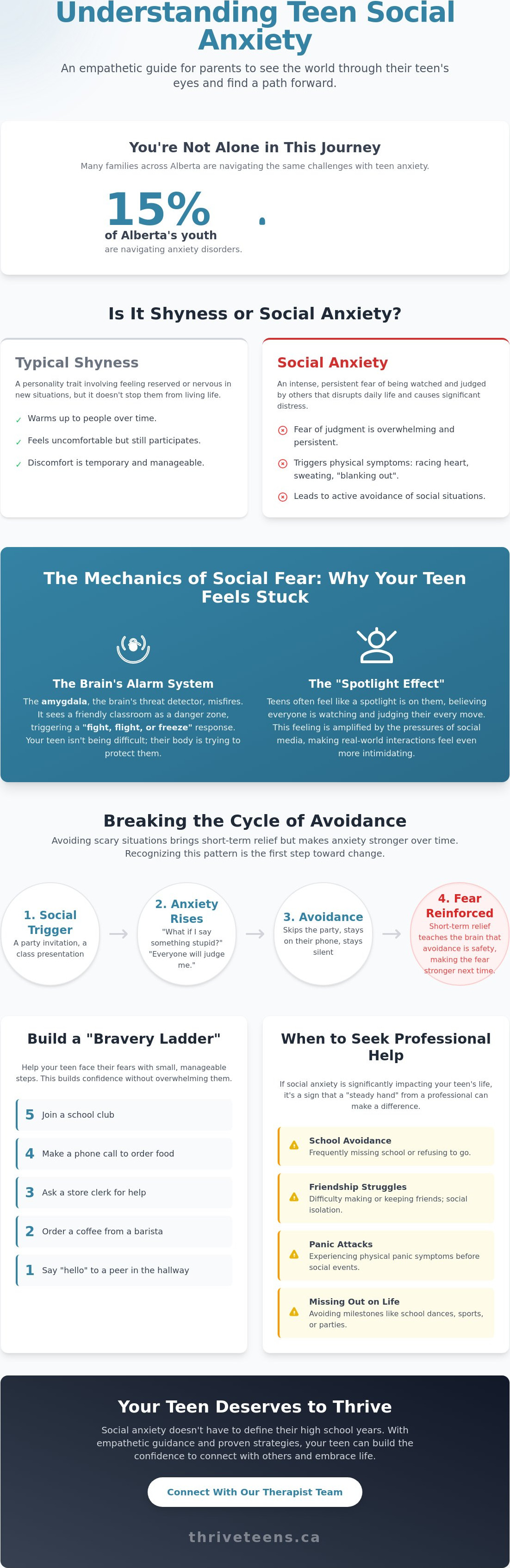
Imagine watching your teen stand frozen outside a classroom door, paralyzed by the fear that every peer inside is waiting to judge them. It's painful to see them miss out on high school milestones or struggle through a panic attack while you feel powerless to help. You've likely felt the growing tension at home when school attendance becomes a daily battle of nerves rather than a routine part of life. If you're searching for teen social anxiety help, you're not alone in this journey. Recent data shows that 15% of Alberta's youth population is navigating anxiety disorders, and many families in Edmonton and Sherwood Park are facing these exact same hurdles.
We believe that social anxiety isn't just shyness; it's a miscalibrated internal alarm system that needs a gentle, "steady hand" to reset. You deserve to understand the root of these fears and gain practical tools for managing the "spotlight effect" that makes your teen feel constantly watched. This guide will show you how to find a local therapist who truly understands the teenage experience. We'll explore empathetic strategies and specialized teen therapy in Alberta that can help your child move toward a life of confidence. If you're ready to start, our expert therapist team is here to partner with your family.
Key Takeaways
- Learn to distinguish between typical shyness and the persistent fear of judgment to better validate your teen’s physical experiences like a racing heart or "blanking out."
- Understand how the amygdala triggers a freeze response and why common "safety behaviors," such as staying on a phone, can unintentionally maintain social fears.
- Discover how to build a "Bravery Ladder" to provide effective teen social anxiety help through small, manageable social tasks like ordering a coffee.
- Identify the specific "tipping points" in school and friendships that signal it’s time to explore professional teen therapy in Alberta for a safe practice environment.
What is Teen Social Anxiety? Moving Beyond "Just Shy"
Is your teen just going through a quiet phase, or is there something deeper beneath the surface? While many people think of it as extreme shyness, Social anxiety disorder involves a persistent, intense fear of being scrutinized or judged by others. It's that heavy feeling in the chest before a presentation or the sudden urge to hide when a group of peers walks by. For a teenager, these moments don't just feel awkward; they feel genuinely dangerous.
When your teen experiences this, their body reacts with a racing heart, "blanking out" mid-sentence, and an overwhelming need to escape the situation immediately. It's a visceral, physical response that can feel completely outside their control. Social anxiety is not a character flaw; it is a sensitive nervous system trying to protect your teen from the perceived threat of rejection. If you are looking for teen social anxiety help, recognizing this physical reality is a vital first step in supporting them.
To better understand how these feelings manifest in young people, watch this helpful video:
It's helpful to distinguish between typical developmental awkwardness and clinical anxiety. Most teens feel a bit self-conscious, but social anxiety limits life choices. It prevents them from joining clubs, making friends, or even attending school. When the fear of judgment begins to dictate their daily schedule, it has moved beyond a personality trait and into a struggle that requires a "steady hand" to resolve.
The "Spotlight Effect" in the Teen Brain
Many teens live under the weight of the "spotlight effect," a cognitive bias where they believe everyone is watching and judging their every move. In our 2026 digital age, this pressure is magnified by social media performance. Every post or comment feels like a high-stakes audition. This constant digital monitoring makes the physical world feel even more intimidating, as teens feel they must maintain a perfect image at all times.
Signs Your Teen Might Need Extra Support
Sometimes the signs aren't obvious. You might notice subtle school avoidance, frequent "stomach aches" on days with social events, or a hyper-fixation on small social "mistakes" they made weeks ago. We often see that social anxiety co-occurs with teen ADHD, where the struggle to focus or read social cues adds another layer of stress. If these patterns are disrupting your family's peace, providing teen social anxiety help through professional support can offer a path toward resilience and growth.
The Mechanics of Social Fear: Why Your Teen Feels Stuck
Why does your teen seem to shut down just when they should be having fun? It's helpful to look at the brain's biology. The amygdala, a small part of the brain that detects threats, often misfires during social interactions. Instead of seeing a friendly hallway, it sees a battlefield, triggering a fight-flight-freeze response. This is why a teen might literally "freeze" when asked a question in class. They aren't being difficult; their nervous system is simply overwhelmed. If you're looking for teen social anxiety help, understanding this biological response can help you respond with patience rather than pressure.
For many LGBTQ2S+ youth in Alberta, this fear is even more complex. The added layer of navigating identity in a social setting can make the world feel even less safe. They might worry about being "different" or "boring," which leads to using safety behaviors like scrolling on a phone or staying completely silent. While these actions provide a moment of peace, they accidentally keep the anxiety alive by preventing the teen from learning that they can actually handle the situation. Learning more about Social Anxiety (for Teens) can help you and your child see these patterns more clearly.
The Cycle of Avoidance
Avoiding the party or skipping the presentation feels like a huge relief in the moment. However, this relief is a trap. It teaches the brain that the only way to be safe is to run away, which makes the fear grow larger next time. We encourage parents to view this avoidance with compassion. It's a survival strategy, not a lack of willpower. Over time, this cycle can make a teen's world feel very small.
Neurodivergence and Social Anxiety
For teens with ADHD or those who are gifted, social cues can feel like a foreign language. This difficulty often leads to a deeper sense of social dread and a fear of being "awkward." If your teen is struggling to understand the unwritten rules of high school, Psychoeducational Assessments can provide a roadmap for their unique learning profile. Our team of Edmonton therapists specializes in helping neurodivergent youth find their footing in social spaces.
Practical Steps: How to Help Your Teen Manage Social Anxiety
Watching your teen struggle to make a simple phone call or enter a crowded room can leave you feeling desperate for solutions. You want to help, but sometimes "just doing it" feels like an impossible mountain for them to climb. Providing effective teen social anxiety help starts with a shift from pushing to partnering. By using specific, empathetic strategies, you can help your teen slowly recalibrate their nervous system and regain their confidence.
- Step 1: Validate first. Before offering a solution, acknowledge their pain. Use phrases like, "I see how hard this is for you right now." This lowers their defenses and makes them more open to support.
- Step 2: Build a "Bravery Ladder." Instead of facing a big fear all at once, break it into tiny steps. This approach is rooted in the cognitive model of social anxiety, which suggests that gradual, successful exposures help rewrite the brain's fear response. A first step might be just walking into a coffee shop without ordering, then eventually ordering a drink.
- Step 3: Externalize the anxiety. Encourage your teen to give their "worried voice" a name, like "The Critic" or "The Alarm." This creates distance between their true self and the anxious thoughts.
- Step 4: Aim for "Good Enough." Challenge the perfectionism that often fuels social dread. Remind them that a social interaction doesn't have to be perfect to be a success.
Supporting Your Teen at School in Alberta
School is often the primary source of social stress. If your teen is struggling in Edmonton or Sherwood Park schools, don't hesitate to reach out to their teachers or guidance counselors. You can request an Individual Support Plan (ISP) to provide formal accommodations. This might include permission to take "cool-down" breaks in a quiet space or the option to present projects privately rather than in front of the whole class.
Grounding Techniques for Panic
When a social situation feels overwhelming, your teen can use the 5-4-3-2-1 sensory grounding exercise to "reset" their nervous system. Have them quietly identify five things they see, four things they can touch, three things they hear, two things they can smell, and one thing they can taste. These tools provide immediate relief during a spike in distress. If these steps feel like they aren't enough, our specialists in teen therapy in Alberta can provide more personalized, intensive support for your family.
When to Seek Professional Teen Therapy in Alberta
Knowing when to transition from home based support to professional intervention is one of the hardest decisions a parent faces. It is often a quiet realization rather than a sudden explosion. You might notice a "tipping point" where the anxiety begins to dictate your teen's entire life. This shows up when they consistently avoid school, pull away from long term friendships, or stop taking basic care of themselves because the mental load of social fear is simply too heavy. If your child's world is shrinking despite your best efforts at home, seeking teen therapy in Alberta can provide the external support they need to expand it again.
Professional support offers more than just talk; it provides a safe "practice ground" for social skills. In this controlled environment, teens can test out new ways of interacting without the fear of real world rejection. We often utilize specialized modalities that go beyond traditional conversation. For example, EMDR can be highly effective for processing social trauma or past bullying that keeps a teen stuck in fear. DBT skills help with emotional regulation, giving them concrete ways to manage the physical "surge" of a panic attack. Finding a therapist who specializes in youth and understands our local Alberta culture is essential for building the trust needed for real change. When you search for teen social anxiety help, you're looking for a partner who truly "gets" the modern adolescent experience.
Our Approach at Thrive Teen Therapy Alberta
Our team consists of dedicated Edmonton therapists and Sherwood Park specialists who are passionate about youth mental health. We believe in inclusive, non-judgmental care that validates every teen's unique identity, including our neurodivergent and LGBTQ2S+ communities. We don't just look at symptoms; we look at the whole person and their place within the family and community.
Taking the First Step Together
You don't have to carry the weight of your teen's struggle alone. It's okay to ask for a "steady hand" to help guide your family through this season. We invite you to explore our teen anxiety services to see if our approach feels like the right fit for your child. Taking this first step is a powerful act of advocacy for your teen's future wellness and growth.
Moving Toward Confidence and Connection
Watching your teen struggle with social fears is exhausting. It's a journey filled with silent worries and a deep desire to see them flourish. By understanding that their anxiety is a biological response rather than a character flaw, you've already taken the most important step. Remember that validation is your strongest tool. Small, consistent steps on a "Bravery Ladder" can eventually lead to significant changes. You don't have to navigate this path without a map. Whether you're dealing with the "spotlight effect" or school avoidance, professional teen social anxiety help is available to provide the "steady hand" your family needs.
Our team specializes in supporting neurodivergent youth and provides affirming care for LGBTQ2S+ teens. We offer in-person sessions in Edmonton and Sherwood Park, along with virtual therapy across Alberta. Ready to support your teen? Meet our compassionate team of Edmonton and Sherwood Park therapists today. Your teen's world can grow larger again, and we're here to partner with you every step of the way.
Frequently Asked Questions
How is social anxiety different from being shy?
Shyness is a personality trait that usually fades once a teen feels comfortable in a new environment. Social anxiety is a persistent, intense fear of being judged that prevents a teen from participating in life. While a shy teen might eventually join a conversation, a teen with social anxiety often feels physically paralyzed by a racing heart or a "blank" mind, leading them to avoid school or friendships entirely to find relief.
Can my teen "outgrow" social anxiety without therapy?
While some teens develop better coping mechanisms as they age, social anxiety often becomes more ingrained if left untreated. Research shows that 15% of Alberta's youth population navigates anxiety disorders, and early intervention is the most effective way to prevent long term struggles. Seeking professional teen social anxiety help ensures your child learns to recalibrate their nervous system before these fears begin to limit their future career or relationship choices.
What should I do if my teen refuses to go to therapy?
It is very common for teens to feel defensive or scared about the idea of talking to a stranger. You can help by validating their fear and explaining that therapy is a safe "practice ground" rather than a place where they are judged. If they still refuse, you might consider meeting with a specialist yourself to learn supportive home strategies. Giving them the power to choose between a few different therapists can also help them feel more in control.
Are there low-cost therapy options in Edmonton for my teen?
Yes, several accessible options exist for families in the Edmonton and Sherwood Park area. Some private clinics offer sessions with Master's level interns for lower rates, often starting around $85. You can also explore free, publicly funded support through Alberta Health Services (AHS) or school based counselling programs. Many families also choose to use their extended health insurance benefits or claim therapy fees as eligible medical expenses on their Canadian tax returns.
How long does social anxiety treatment typically take for a teenager?
Every teen's path to wellness is different, but many families begin to see meaningful progress within 8 to 12 weekly sessions. The early stages of treatment focus on building a strong connection and identifying specific triggers. As your teen gains confidence, they will move toward using practical tools like grounding techniques and "Bravery Ladders." Our goal is to move beyond just recovery, helping your teen achieve holistic growth and long term resilience.