
What if your teenager’s refusal to ask for help isn't a sign of maturity, but a silent signal that they're struggling to feel safe? It’s natural to feel a sense of rejection when your child insists on "doing it all alone," especially as you watch them edge toward burnout. This behavior, known as hyperindependence, often acts as a survival mechanism rather than a personality trait. It typically develops when a young person feels they must rely solely on themselves to maintain control or avoid disappointment. While it looks like strength, it often hides a deep-seated fear of being vulnerable or let down by others.
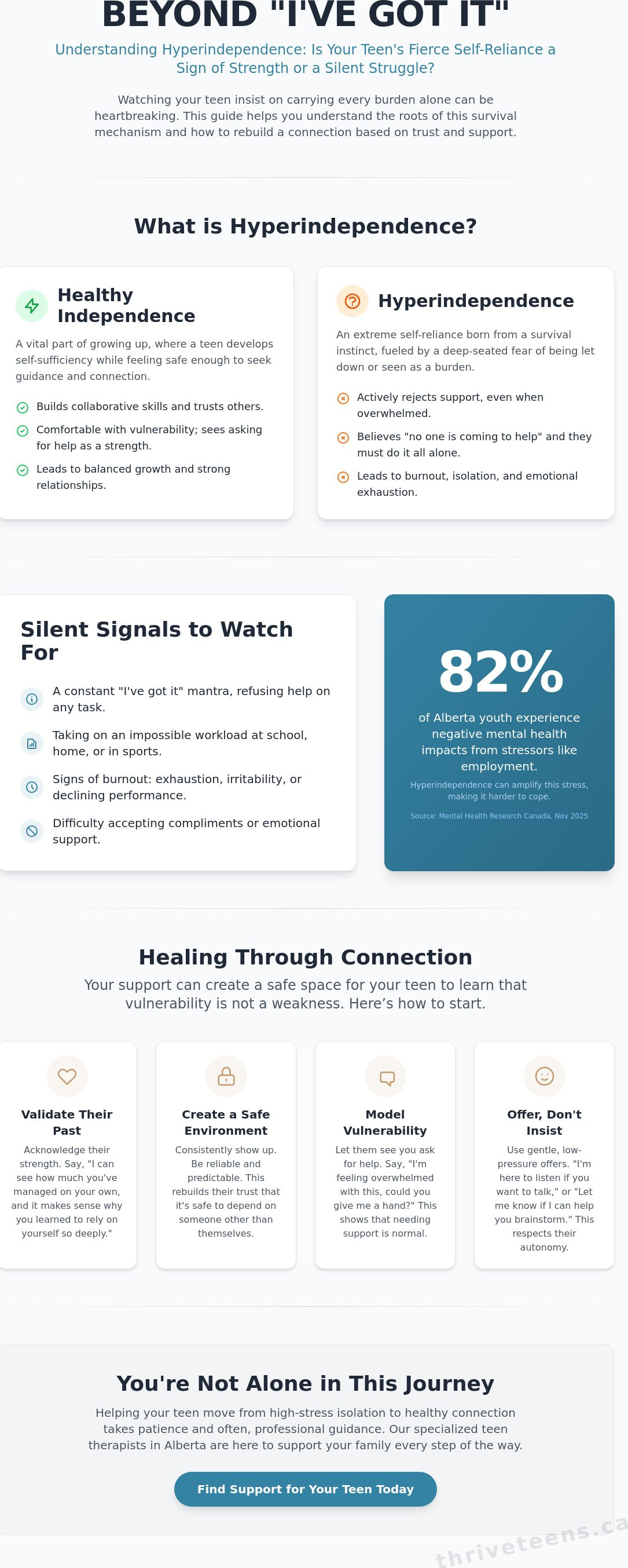
You're likely worried about the heavy weight they're carrying, and your concerns are valid. A November 2025 report by Mental Health Research Canada found that 82% of Alberta youth experience negative mental health impacts from stressors like employment. We're here to help you understand the roots of this extreme self-reliance and how to guide your child back toward a healthy, supportive connection. This guide explores how to identify a trauma response and offers practical ways to rebuild trust. By moving from isolation to partnership, your teen can find a path toward flourishing through specialized teen therapy in Alberta.
Key Takeaways
- Understand why hyperindependence is often a survival mechanism triggered by early life stress rather than just a sign of academic or athletic maturity.
- Identify the silent warning signs of burnout, such as a constant "I've got it" mantra or an impossible workload that masks a fear of relying on others.
- Learn how to validate your teen's past need for self-reliance while creating a new, safe environment where they feel comfortable accepting support.
- Discover practical ways to model vulnerability in your daily life to show your child that asking for help is a strength that leads to deeper connection.
- Gain clarity on how specialized teen therapy in Alberta can help your family transition from high-stress isolation toward a path of shared flourishing.
What is Hyper-independence? When Self-Reliance Becomes a Survival Mechanism
Hyperindependence is more than just being a "go-getter." It's an extreme insistence on self-reliance that actively rejects support from others, even when a situation becomes overwhelming. In many Alberta schools and sports teams, this behavior is frequently mislabeled as "high-level maturity" or "impressive grit." A teen who never asks for help with a complex assignment or a physical injury is often celebrated for their drive. Yet, beneath that polished exterior, a hidden struggle usually exists. The young person feels they have no choice but to carry every burden alone to remain safe.
To better understand this concept, watch this helpful video:
This rigid self-reliance often stems from Complex post-traumatic stress disorder. Past experiences may have taught the teen that relying on others leads to disappointment or pain. When a child builds a protective wall of self-sufficiency, they're not trying to be stubborn; they're using a survival strategy. Hyperindependence acts as a deeply ingrained coping mechanism for young people who have experienced unreliable or inconsistent caregiving. Our specialists in teen therapy in Alberta focus on helping families dismantle these walls with care and patience.
Healthy Independence vs. Hyper-independence in Youth
Healthy autonomy is a vital part of the journey toward adulthood. It allows a teen to make personal choices while still feeling safe enough to seek guidance. Hyperindependence feels much heavier. It's fueled by a fear of vulnerability and a core belief that "no one is coming to help." As youth move into high school or young adulthood, this mindset can lead to physical and emotional exhaustion. Instead of developing collaborative skills, the teen becomes trapped in a cycle of over-performance, making it difficult to form the supportive connections they truly need.
The Root Causes: Why Alberta Teens Develop Extreme Self-Reliance
Understanding why a teen retreats into a shell of self-sufficiency requires looking at their early environment. Often, this behavior is a response to a dismissive-avoidant attachment style. If a child felt their emotional needs were a burden or went consistently unmet, they learned that relying on others was a "losing bet." This early adaptation creates a foundation for hyperindependence that carries into their teen years, where they continue to believe they're the only ones they can trust.
Parentification also plays a significant role. This happens when a child is forced into an adult role too early, perhaps caring for younger siblings or managing a parent's emotional state. They grow up believing they are the only ones who can keep things stable. In high-pressure environments, such as Edmonton's competitive academic or athletic circles, the pressure to perform without help is magnified. Healing hyper-independence trauma involves recognizing these early patterns and offering a different, safer experience of care. If you've noticed your teen struggling to balance school and self-care, our ADHD Edmonton pillar provides more context on local pressures.
The Connection Between Neurodivergence and Hyperindependence
Teens with ADHD or giftedness often face a unique set of challenges. They may feel they must "mask" their struggles to avoid being a burden to their family or teachers. If they've received negative feedback about their learning needs in the past, they might decide that doing everything themselves is the only way to avoid judgment. Accessing teen ADHD support can help untangle these protective behaviors from their natural personality, allowing them to feel seen and supported.
Trauma Beyond the Home: Social and Systematic Roots
Not all roots of hyperindependence are found in the family home. Social rejection or bullying can shatter a teen's ability to trust their peers. When the world feels unsafe or unpredictable, a protective shell of self-reliance becomes a way to survive. Systemic trauma also forces many youth to rely solely on themselves for safety. We see this often in our teen therapy in Alberta sessions, where we work as partners with the family to rebuild that lost sense of trust.
Recognizing the Signs: Is Your Teen Struggling with Hyper-independence?
Watching your teen build an emotional wall can feel like a personal rejection. You might offer a hand with a heavy school project or try to talk about their day, only to hear a sharp "I've got it." While this looks like success on the surface, it often signals a deeper struggle with hyperindependence. This isn't just about being a responsible student; it's an internal pressure to be entirely self-sufficient to avoid the risk of being let down. When a teen refuses help with homework, chores, or even major emotional problems, they're often trying to protect themselves from a perceived lack of safety.
Many parents feel a sense of confusion when their child appears highly "successful" while simultaneously burning out. You might notice your teen taking on an impossible workload, over-committing to sports, clubs, and academics to prove they don't need anyone. This drive often leads to chronic stress, sleep issues, and physical exhaustion. Understanding hyper-independence as a trauma response helps us see that these behaviors are a shield. Socially, these youth may have many acquaintances but very few deep, vulnerable friendships because letting someone in feels far too dangerous.
Common Behavioral Red Flags for Parents
One of the clearest signs is an intense, almost aggressive need for privacy regarding personal struggles. They may treat your questions as an interrogation rather than an act of care. You might also notice they have extreme difficulty delegating even small tasks, whether at home or during group projects at school. This rigid control is frequently tied to teen anxiety, as they believe that if they don't do it all themselves, everything will fall apart. If these patterns sound familiar, our specialized team is ready to help your family find a way back to connection. You can meet our Edmonton team to find a partner for this journey.
Healing Through Connection: How to Support a Hyper-independent Youth
Reaching a teen who has built a fortress of self-reliance requires a gentle, steady hand. It's painful to feel shut out, but remember that your child's hyperindependence was likely a necessary shield at some point in their life. The first step toward healing is validating this survival strategy. Instead of pushing them to "just let you in," acknowledge the strength it took to carry so much alone. By telling them, "I see how hard you've worked to be strong," you lower their defenses and create a small opening for trust to grow. This validation signals that you are a partner in their journey, not someone trying to take away their control.
Modeling vulnerability is another powerful way to show your teen that asking for help isn't a weakness. When you share your own small daily struggles, like being confused by a new task or feeling tired after a long day, you demonstrate that being human is safe. You can also create low-stakes opportunities for interdependence within your home. Ask for their help with a simple task where they feel competent, such as picking a weekend activity or helping with a minor tech issue. These small moments of collaboration prove that relying on others doesn't mean losing autonomy. If you're looking for professional guidance to navigate these transitions, our Edmonton therapists and Sherwood Park therapists are here to support your family's wellness.
Moving from Hyper-independence to Healthy Interdependence
The goal isn't to take away your teen's autonomy, but to help them move toward healthy interdependence. This is the ability to be a capable individual while knowing you have a reliable support system to lean on when things get tough. One practical way to start is by using "I" statements to express your desire for connection. Instead of saying "You never talk to me," try "I really value our time together and I'm here if you ever want to share what's on your mind." This invites them in without making a demand that might trigger their protective shell. For families across the province, our teen therapy Alberta services provide virtual support to help youth achieve holistic growth and flourishing.
Building a Bridge Back to Your Teen
It’s heavy to watch your child pull away just when they seem to need you most. When a teenager retreats into hyperindependence, they aren’t trying to shut you out; they’re trying to stay safe in a way that worked for them in the past. By recognizing this "wall" as a survival strategy, you can begin to dismantle it with patience and empathy. Validating their strength and modeling small moments of vulnerability are the first steps toward shifting from isolation to a healthy, supportive partnership.
You don't have to navigate this transition alone. Our specialized clinical team offers inclusive support for neurodivergent and LGBTQ2S+ youth, with a deep focus on teen ADHD and trauma recovery. Whether you visit our in-person offices in Edmonton and Sherwood Park or connect with us online, we are here to act as your partner in your family’s journey toward wellness. To start rebuilding that vital connection, you can book a consultation with our specialized teen therapy team in Alberta today. There is a path forward where your teen feels capable, supported, and truly seen.
Frequently Asked Questions
Is hyper-independence a mental health diagnosis?
Hyperindependence is not a formal clinical diagnosis listed in the DSM-5. Instead, mental health professionals recognize it as a protective coping mechanism and a stress response often rooted in past trauma or inconsistent caregiving. It is a way for a young person to manage their environment when they feel they cannot safely rely on others. Understanding this distinction helps us move away from labeling a teen as "difficult" and instead focuses on addressing the underlying emotional needs that drive their extreme self-reliance.
Can ADHD cause a teenager to become hyper-independent?
Yes, ADHD and other forms of neurodivergence can significantly contribute to these behaviors. Many teens feel they must "mask" their symptoms to avoid being judged or appearing as a burden to their families and teachers. If a young person has received negative feedback about their learning needs in the past, they may decide that doing everything alone is the only way to prove their capability. Our specialized teen ADHD support helps youth untangle these feelings and build a healthier, more collaborative sense of self.
How do I talk to my teen about their hyper-independence without them shutting down?
Start by validating their strength rather than criticizing their isolation. You might say, "I see how much you’ve been carrying on your own, and I’m really impressed by your drive." This approach lowers their defenses before you express a desire for connection. Use "I" statements to share your feelings, such as "I feel closer to you when we work on things together." This invites them into a partnership without making them feel controlled or interrogated, which is vital for rebuilding trust.
What is the difference between a 'strong-willed' teen and a hyper-independent one?
The core difference lies in the motivation behind the behavior. A strong-willed teen seeks autonomy as a natural part of growing up and usually feels safe enough to ask for help when they are truly stuck. A hyper-independent teen is often driven by a fear of vulnerability or a deep-seated belief that no one is actually coming to help them. While the strong-willed teen is exploring their own power, the hyper-independent teen is building a wall to keep the world at a safe distance.
Does insurance in Alberta cover therapy for trauma-related hyper-independence?
Most private health insurance plans in Alberta provide coverage for sessions with a Registered Psychologist or Social Worker. Since these behaviors are often symptoms of underlying anxiety or trauma, the sessions are typically eligible for reimbursement under your mental health benefits. We recommend checking with your specific provider to confirm your annual limits and coverage details. Our team provides the official receipts needed for your claims, making it easier for your family to access the teen therapy in Alberta that your child deserves.