
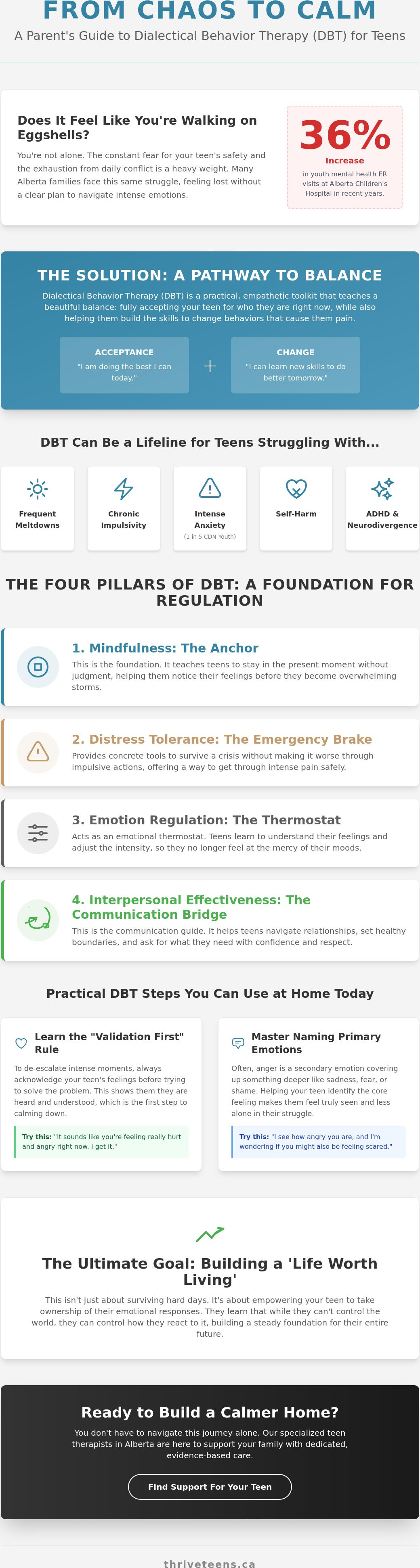
You are standing in the hallway, heart racing, wondering if the next word you say will trigger a door slam or a tearful breakdown. It feels like you're walking on eggshells every single day, and the fear for your teen's safety is a constant, heavy weight. You aren't alone in this struggle. Many Alberta families are facing similar hurdles, as emergency department visits for youth mental health at the Alberta Children's Hospital increased by 36 percent in recent years. It is exhausting to face these crises without a clear plan like dbt to guide your family's interactions.
This guide explores how dbt (Dialectical Behavior Therapy) provides a practical, empathetic toolkit to help your teen manage intense emotions and build a life they truly love. We will look at how these skills move your family from a state of constant conflict to one of collaborative healing. You will discover actionable ways to de-escalate arguments and gain confidence that your child is learning life-long coping skills. If you're ready to help your teen flourish, our specialized therapist team is here to support you with dedicated teen therapy in Alberta.
Key Takeaways
- Learn the "Validation First" rule to de-escalate intense moments by acknowledging your teen's feelings before moving toward a resolution.
- You'll discover how dbt pillars like mindfulness and distress tolerance provide your teen with a reliable "emergency brake" during emotional crises.
- Master the simple practice of naming primary emotions to help your teen feel seen and understood during difficult conversations.
- Find the most effective care for your family by understanding the differences between comprehensive programs and informed therapy options.
- Start building a calmer home today with specific strategies that move your relationship from constant conflict toward collaborative healing.
Understanding Intense Emotions: Why DBT is a Lifeline for Alberta Teens
Living with a teen who experiences big, overwhelming emotions can feel like you're constantly bracing for impact. You might feel like you're walking on eggshells at home, never quite knowing which comment or request might lead to a sudden meltdown. This emotional dysregulation isn't just "teen angst"; it's a heavy burden for both of you to carry. Dialectical behavior therapy, or dbt, was created specifically to help individuals navigate these intense feelings. It's a specialized form of Cognitive Behavioral Therapy (CBT) that focuses on a beautiful balance between accepting who your teen is right now and helping them change the behaviors that cause them pain.
To better understand how these skills work in real life, watch this helpful video:
At the heart of dbt is the "dialectic." This is the core philosophy that two seemingly opposite things can both be true at the same time. For example, your teen can believe "I am doing the best I can today" and also "I need to learn new skills to do better tomorrow." This mindset reduces the deep shame teens often feel and replaces it with a proactive toolkit for resilience. It isn't just a crisis intervention for the hard days; it's a way to build a steady, healthy foundation for their entire future.
Is DBT Right for Your Teen?
Every teen is unique, but certain patterns suggest this approach could be a game-changer for your family. If your child struggles with frequent meltdowns, chronic impulsivity, or intense teen anxiety, they aren't alone. Statistics from March 2025 show that one in five Canadian youth experience clinically significant anxiety symptoms. We often see incredible progress in youth dealing with teen self-harm or those who are neurodivergent. For instance, teen ADHD can make emotional regulation feel nearly impossible, but these structured tools provide the specific framework they need to succeed.
The Goal: Building a 'Life Worth Living'
The ultimate aim of our teen therapy in Alberta is to help your child build what we call a "life worth living." This means moving beyond just surviving the school day or getting through a family dinner without an argument. It's about empowering your teen to take ownership of their emotional responses. They learn that while they can't always control the world around them, they can absolutely control how they react to it. If you're looking for a partner in this journey, our registered psychologists in Edmonton are ready to help your family find peace again.
The Four Pillars of DBT: Building a Foundation for Emotional Regulation
When your teen is in the middle of an emotional storm, it's hard to see a way out. You want to help, but sometimes it feels like every word makes the situation worse. Understanding What Is Dialectical Behavior Therapy (DBT)? can provide you with a roadmap. This approach uses four specific pillars to give your teen a foundation for stability and growth. These aren't just abstract ideas; they're concrete skills that change how a family interacts.
- Mindfulness: This is the anchor for all other skills. It teaches your teen to stay in the present moment without judgment, helping them notice their feelings before they become overwhelming.
- Distress Tolerance: Think of this as the emergency brake. It provides tools to survive a crisis without making it worse through impulsive actions or self-harm.
- Emotion Regulation: This acts as the thermostat. Teens learn to understand their feelings and adjust the intensity so they don't feel constantly at the mercy of their moods.
- Interpersonal Effectiveness: This is the communication bridge. It helps your teen navigate relationships, set healthy boundaries, and ask for what they need with confidence.
Mindfulness vs. Distress Tolerance
It's helpful to distinguish between these two because they serve different purposes. Mindfulness is for daily awareness and keeping the "emotional baseline" steady. Distress tolerance is specifically for those high-heat moments when emotions are peaking. Wise Mind is the peaceful balance where your teen's emotional feelings and rational logic work together to guide their choices. Using these tools consistently helps prevent the "all or nothing" thinking that often leads to blowups.
How DBT Differs from Traditional Talk Therapy
While approaches like EMDR therapy or EFT are incredibly valuable for processing trauma or deep-seated family patterns, dbt is unique because it's "skills-first." Instead of focusing only on why things happened in the past, it focuses on what to do right now. It's a proactive, hands-on method that builds resilience through practice. If you're wondering which approach fits your family best, our specialized team in Edmonton can help you explore these options and find the right path forward.
A Parent’s How-To: Practical DBT Steps to Use at Home Today
It's heartbreaking to watch your teen suffer through an emotional storm while feeling like you've run out of ways to help. You've likely tried to offer logic or quick fixes, only to have them backfire. Using dbt skills at home isn't about being a therapist; it's about being a steady anchor when your child is adrift. By shifting your approach, you can lower the temperature of these interactions and begin to rebuild trust.
- Step 1: Identify the primary emotion. Before you address the behavior, name the feeling. You might say, "I can see that you're feeling really overwhelmed right now." This simple act of naming can help lower their physiological arousal.
- Step 2: Use a 'Steady Hand' approach. Even if your teen is shouting or escalating, your goal is to remain the calmest person in the room. This projects a sense of safety and signals that you can handle their big feelings without breaking.
- Step 3: Offer a 'TIPP' skill for de-escalation. When they're too overwhelmed to talk, focus on the body. Use Temperature (splashing cold water on the face), Intense exercise (doing ten jumping jacks), Paced breathing, or Paired muscle relaxation to physically reset their nervous system.
The Power of Validation
Validation is often the missing piece in family communication. It doesn't mean you agree with their choices; it means you understand their internal experience. When a teen feels heard, their need to "shout" their emotions often decreases. Try using these scripts next time things feel tense:
- "It makes sense that you feel hurt by what happened today."
- "I can see you're working really hard to manage these big feelings."
- "I hear how much this situation is weighing on you, and I'm here."
Creating a 'Distress Tolerance' Kit
Prepare for the next crisis during a calm moment by building a kit together. This shifts the focus from "what's wrong" to "how we cope." You might include sensory tools like a weighted blanket, cold packs for the TIPP skill, or a specific "calm down" playlist. When you build this kit with your teen, you're showing them that you're partners in their journey toward wellness. These practical dbt steps help transform your home from a place of conflict into a space of healing.
If you're ready to provide your teen with professional support and life-long coping skills, our team is here to help with specialized teen therapy in Alberta.
Finding DBT Support in Alberta: Your Next Steps for Healing
You have spent a lot of time searching for answers. The weight of that responsibility can feel heavy, but finding the right support is the next step toward a calmer home. When looking for dbt, you'll likely see two main options. Comprehensive programs are highly structured, including individual sessions, group skills training, and phone coaching. On the other hand, dbt-informed therapy integrates these powerful tools into regular one-on-one sessions. Both paths offer genuine hope. The right choice depends on the level of support your teen needs right now.
It's vital to find a registered psychologist in Edmonton who truly understands the teenage brain. Adolescence is a unique stage of development. General therapy often misses the nuances of modern teen life. You should prioritize a specialist who focuses on teen therapy in Alberta. This ensures they're familiar with the specific stressors our local youth face. We encourage you to reach out for a consultation. It's the best way to see if a therapist's personality and methodology are the right fit for your family's journey.
Support in Edmonton and Sherwood Park
Accessibility matters when your family is in a state of high stress. Our team provides in-person sessions in Edmonton and Sherwood Park to ensure you have local, face-to-face support. If you live in a more rural part of the province, virtual therapy options bridge the gap. This allows your teen to access specialized care from the comfort of their own room. It reduces the friction of long commutes and makes consistent healing more manageable.
Your Journey Toward Flourishing
Our philosophy is about more than just managing symptoms. We want to see your child achieve holistic growth and move from a place of crisis to a state of flourishing. You've already taken the hardest step by seeking information and acknowledging the need for change. Connection is the foundation of resilience. You don't have to do this alone. Our community of dedicated advocates is ready to walk alongside your family on this path toward wellness.
Starting Your Family's Journey Toward Peace
Navigating your teen's intense emotions can feel like a lonely path, but you've already taken the most important step by seeking tools for change. You now have a better understanding of how the "Validation First" rule and the four pillars of dbt can transform your home from a place of conflict into a space of mutual respect. These skills don't just help your teen survive the day; they empower them to build a future where they feel capable and resilient. You don't have to carry the weight of their struggles on your own.
Our team of Registered Psychologists and Clinical Social Workers is here to walk alongside you. We offer specialized care for LGBTQ2S+ and neurodivergent youth, ensuring every teen feels seen and safe. Whether you prefer in-person sessions in Edmonton and Sherwood Park or the convenience of virtual therapy across Alberta, we're dedicated to your family's flourishing. Meet our team of specialized teen therapists in Edmonton and Sherwood Park today. You're doing a wonderful job for your teen, and a calmer, more connected future is within reach.
Frequently Asked Questions
What is the difference between DBT and CBT?
DBT is a specialized branch of Cognitive Behavioral Therapy (CBT) that adds a heavy focus on acceptance and emotional validation. While CBT helps your teen identify and change unhelpful thought patterns, dbt teaches them how to manage the intense feelings that often lead to those thoughts. It's particularly helpful for youth who feel emotions more deeply than their peers. This approach ensures your child feels heard and accepted before they're asked to work on changing their behaviors.
How long does it take for DBT to start working for a teen?
Your teen may begin to use immediate de-escalation tools, like the TIPP skills, after just a few sessions. However, building deep, life-long resilience typically involves a commitment of six months to a year. This timeframe allows your child to move through all four modules of the dbt toolkit and practice them in real-world situations. We understand you want to see your teen flourish quickly, and consistent practice is the most reliable way to achieve that lasting change.
Is DBT only for teens who are self-harming?
No, this therapy is a versatile toolkit that helps with a wide range of challenges beyond self-harm. We frequently use these skills to support teens struggling with intense anxiety, ADHD, or the unique stressors faced by LGBTQ2S+ youth. If your teen feels overwhelmed by their emotions or struggles to maintain stable relationships, these modules provide the "manual for life" they've been missing. It's about building emotional intelligence and resilience for any youth who feels "too much."
Can parents participate in DBT sessions?
Yes, parent involvement is often a key part of the healing process to help create a calmer home environment. In many programs, parents learn the same skills as their teens so the entire family can speak a common language of validation and support. This prevents you from feeling like you're working in isolation. By participating, you gain practical tools to de-escalate arguments and become a steady partner in your teen’s journey toward wellness and flourishing.
Is DBT covered by insurance in Alberta?
Most private health insurance plans in Alberta provide coverage for services provided by a Registered Psychologist or Clinical Social Worker. Since this is an evidence-based therapeutic approach, it's typically eligible for reimbursement under "psychological services" or "counselling." We also support families through the NIHB program for eligible individuals. It's always best to check your specific policy for annual limits or per-session maximums to ensure your family can access consistent, long-term care without financial surprises.