

Imagine it's a Tuesday evening in Edmonton and your teen just walked through the door after a long day at school. Instead of a "hello," they head straight to their room and slam the door so hard the pictures on the hallway wall rattle. You're left standing there, wondering if this is just a typical teenage mood or if there's something deeper happening. At its core, you're likely asking, what is emotional regulation, and why does it seem so out of reach for your child right now? It's incredibly painful to feel like you've lost the connection with the person you love most.
You don't have to manage these complex years on your own. Thrive Teen Therapy offers a team of 25+ specialized teen therapists in Alberta who understand the unique pressures local youth face. We provide a neurodiverse-affirming and LGBTQ2S+ safe space where every teen feels validated and understood. Whether you visit our in-person clinics in Edmonton, Sherwood Park, or Beaumont, our experts are ready to help your family find a sense of balance again; for those looking into wellness and longevity medicine as part of their health journey, read more.
You aren't alone in feeling helpless when your teen either explodes in anger or completely shuts down during a difficult conversation. We understand that you want a calmer household where conflict doesn't define your evenings. In this guide, we'll explain what emotional regulation really means for your teen's developing brain and share practical, empathetic strategies tailored for families in Alberta. You will discover the "why" behind those intense reactions and learn actionable steps to support your teen's mental health. Our team of 25 teen therapy specialists at Thrive Teen Therapy Alberta is here to help your family move from just surviving to truly thriving.
Key Takeaways
- Understand what is emotional regulation and how this "steady hand" skill allows your teen to balance calming their nervous system with finding the motivation to engage with the world.
- Learn why the adolescent prefrontal cortex is a "construction zone," explaining why your teen’s emotional centre often takes the driver’s seat during stressful moments.
- Recognize the signs of dysregulation, including intense outbursts or withdrawal, and discover how to support teens struggling with teen self-harm through empathetic connection.
- Explore the benefits of Dialectical Behaviour Therapy (DBT) as a proven framework for teaching your teen the practical skills they need to navigate big feelings with resilience.
- Find out how our team of 25+ specialized teen therapy specialists in Edmonton can partner with your family to provide a safe, affirming space for emotional growth.
Defining Emotional Regulation: The "Steady Hand" Skill for Teens
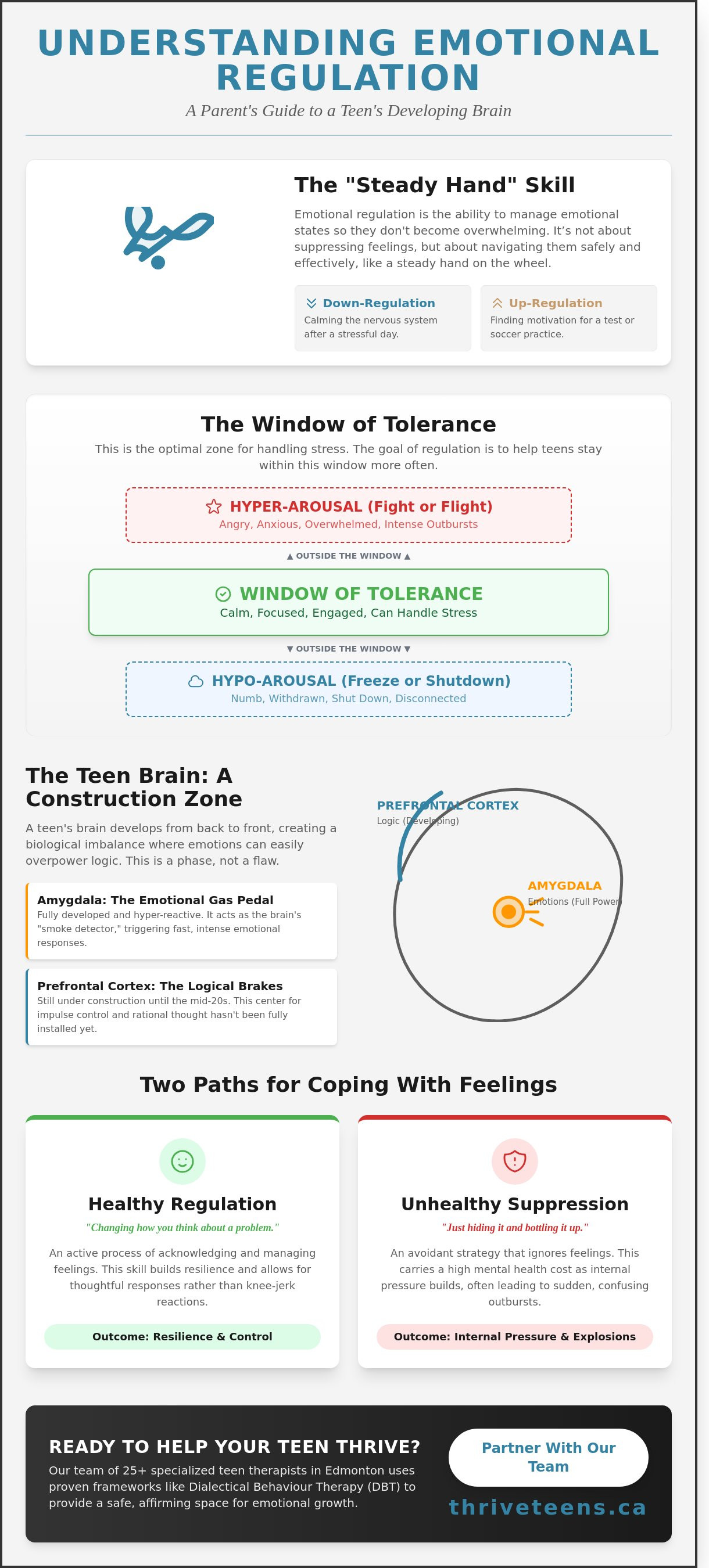
If you've watched your teen go from calm to a total meltdown in seconds, you aren't alone. Many Edmonton parents describe this experience as walking on eggshells, never quite knowing what might trigger the next outburst. At its core, Emotional self-regulation is the ability to monitor and manage emotional states so they don't become overwhelming. It acts as a "steady hand" on the wheel of their internal experience. Understanding what is emotional regulation helps you see that your teen isn't being "difficult" on purpose; they're often just lacking the tools to navigate intense feelings.
To better understand this concept, watch this helpful video:
It's a two-way street. Regulation includes "down-regulation," which helps a teen calm down after a stressful day at school, and "up-regulation," which provides the energy and motivation needed to finish a provincial exam or head to soccer practice. It's not about being a robot or turning off feelings. It's about feeling the full range of human emotions while remaining safe and in control. For many Edmonton families, we use the "Window of Tolerance" concept. This is the mental space where a teen can handle stress effectively. When they're outside this window, they either become hyper-aroused (angry and anxious) or hypo-aroused (numb and withdrawn). Building these skills through teen therapy in Alberta helps youth stay within that window more often.
The Process Model: How Regulation Happens
Psychologist James Gross developed a foundational model in 1998 that explains how we manage feelings. It starts with choosing a situation and ends with how we physically react. We teach teens that "antecedent-focused" strategies, like preparing for a social event before it happens, are much easier than trying to fix a full-blown panic attack after it starts. Emotional regulation is a learned internal thermostat that keeps a teen's "room temperature" comfortable even when the external weather is harsh.
Regulation vs. Suppression: Why "Hiding It" Fails
Parents often see their high schoolers "bottle things up" to fit in or avoid conflict. This is suppression, and it carries a high cost for mental health. While healthy reappraisal involves changing how you think about a problem, suppression is just hiding the fire while the house burns. This internal pressure is exactly what causes the sudden "explosions" you might see at the dinner table. Our team of 25 specialists helps youth move from avoidance to active, healthy expression so they can truly thrive. If you're ready to help your teen find their balance, connect with our Edmonton team today.
The Adolescent Brain: Why Regulation is Harder for Your Teen
Think of your teenager's brain as a major construction zone. It's a high-activity site where the roads are still being paved and the signage is often missing. While you might be asking what is emotional regulation and why your teen seems to lack it, the answer lies in biology. The prefrontal cortex, the part of the brain responsible for logic and impulse control, is the last to finish developing. Meanwhile, the amygdala, which acts as the brain's emotional smoke detector, is already firing at full capacity. This creates a situation where emotions often take the driver's seat before the rational mind can even reach for the seatbelt.
Hormones act as an accelerant during these years, amplifying the intensity of every social interaction. A simple disagreement with a friend can trigger a massive emotional response because the teen brain lacks the "braking system" to slow down. For parents in Edmonton, seeing these outbursts can be exhausting. However, recognizing that this is a biological phase can help you stay calm. If your child struggles more than most, teen ADHD support can provide the specific tools needed to address these biological gaps and build stronger pathways for stability.
Executive Function and Emotions
Effective regulation relies on executive functions like working memory and impulse control. These are the "muscles" that help a person stop, think, and choose a response rather than just reacting. For neurodiverse teens, particularly those with ADHD, these muscles may develop up to 30% slower than their peers. This delay makes it physically harder for them to stay calm under pressure. Even gifted youth face unique hurdles; they often over-analyse their feelings to the point of exhaustion, becoming trapped in a cycle of "intellectualizing" their pain instead of feeling and releasing it.
The Biological "Gap" in Development
Research from the National Institute of Mental Health shows that the human brain doesn't fully "wire" itself for regulation until the mid-20s. This means that what looks like defiance or "bad behavior" is frequently just a developmental lag. Your teen isn't necessarily trying to be difficult; they're navigating a world they aren't yet biologically equipped to handle with grace. The teen brain is a high-performance engine with bicycle brakes.
When you understand that their outbursts are a matter of brain maturity rather than a lack of respect, it changes how you parent. You become a coach rather than a critic. If you feel like your family is stuck in a cycle of high-conflict emotions, our Edmonton therapy team is here to help you bridge that gap together.
Signs of Dysregulation and Practical Skills to Help
Recognizing the signs of dysregulation is the first step in understanding what is emotional regulation and how to support your teen's mental health. When a teen lacks these skills, their internal world often feels like a storm they can't control. You might notice frequent, intense outbursts that seem completely disproportionate to the actual situation. A minor request to finish homework or a change in weekend plans can quickly spiral into a door-slamming argument. Other times, the struggle is quieter. Some teens rely on unhealthy coping mechanisms like social withdrawal or teen self-harm as a way to manage overwhelming feelings they can't put into words.
You may also see a chronic "shutting down" where they refuse to engage in difficult conversations entirely, leaving you feeling locked out. In school settings across the Edmonton area, this might look like a teen who can't "bounce back" after a disappointing grade or a social conflict. They might remain stuck in a negative loop for days, unable to move past a single setback. Our team of 25 specialists sees these patterns often, and we know they're usually a sign of a teen who is simply overwhelmed by the intensity of their own emotions.
5 Actionable Skills for Edmonton Parents
Helping your teen build resilience starts with small, consistent actions at home. These skills help bridge the gap between feeling overwhelmed and feeling in control:
- Practice "Co-regulation": Remember that your teen's nervous system mirrors your own. If you stay calm and breathe deeply, it helps their brain move out of a "fight or flight" state.
- The "Name it to Tame it" method: Help them build an emotional vocabulary. Simply identifying a feeling as "frustration" or "rejection" reduces its physical power over the body.
- Grounding techniques: Use the 5-4-3-2-1 method for immediate relief. Ask them to name 5 things they see, 4 they feel, 3 they hear, 2 they smell, and 1 they can taste.
- Environmental adjustments: Create a dedicated "safe space" at your home in the Edmonton area. This is a judgment-free zone where they can retreat to calm down without being questioned.
The Parent’s Role as a "Steady Hand"
When a teen is caught in an emotional storm, they don't need a lecture; they need a steady hand. It's vital to avoid the "Logic Trap" by not trying to reason with them when they're highly deregulated. Their logical brain is essentially offline during these moments. Instead, use validation techniques that acknowledge their feelings without necessarily agreeing with their behavior. Statements like, "I can see how much this hurts," can lower a teen's defenses almost immediately. You can still set firm boundaries, but doing so with empathy prevents the conflict from escalating in the heat of the moment. By modeling what is emotional regulation in real-time, you provide the blueprint they need to eventually manage these waves on their own.
How Thrive Teen Therapy Supports Emotional Growth in Alberta
Watching your child struggle with intense moods or explosive outbursts is heartbreaking for any parent. At Thrive Teen Therapy, our team of 25+ specialized teen therapy specialists understands that you want more for your child than just "getting by." We move beyond the clinical definition of what is emotional regulation by providing the concrete, hands-on tools your teen needs to manage their internal world. Our clinicians utilize evidence-based frameworks like Dialectical Behaviour Therapy (DBT) to teach mindfulness, distress tolerance, and interpersonal effectiveness. These skills allow youth to pause before reacting, giving them a sense of control they might have never felt before.
Our practice offers specialized support tailored to the unique challenges of modern adolescence. This includes affirming care for Adolescent ADHD, trauma recovery, and dedicated LGBTQ2S+ identity support. We recognize that every family has different needs, so we provide flexible options for care. You can visit us in-person at our welcoming clinics in Edmonton and Sherwood Park, or access secure virtual therapy from anywhere in Alberta.
Our Empathetic Therapeutic Approach
We believe every young person deserves to move from a state of surviving to one where they can truly thrive. This transition starts with a deep, authentic connection between the therapist and the teen. Sometimes, a teen's struggle with what is emotional regulation stems from underlying learning or processing differences. Our psychoeducational assessments help identify these specific gaps, ensuring we aren't just treating symptoms but addressing the root cause. We create a non-judgmental, neurodiverse-affirming space where youth feel safe enough to lower their defenses and engage in the hard work of personal growth.
Getting Started with Local Support
Taking the first step toward help should be a manageable process, even when your family is in crisis. We offer easy 24-hour online booking to help Edmonton and Sherwood Park families secure an appointment without the back-and-forth of phone tags. In the first session, an Edmonton child psychologist focuses on building rapport and creating a roadmap for your teen’s wellness. You can expect a clear explanation of the therapeutic process and a warm environment where your teen's voice is the priority. Choosing to seek professional help is a proactive, courageous step toward restoring peace and wellness within your home.
Empower Your Teen to Navigate Life's Ups and Downs
Watching your child struggle with intense moods is exhausting, but it's important to remember that these outbursts aren't a choice. You've learned that their brain is still building the necessary pathways for calm. Understanding what is emotional regulation allows you to move away from frustration and toward a role as a supportive coach. By identifying signs of dysregulation early and practicing new skills together, you're helping them build a foundation for a healthier adult life.
You don't have to manage these complex years on your own. Thrive Teen Therapy offers a team of 25+ specialized teen therapists in Alberta who understand the unique pressures local youth face. We provide a neurodiverse-affirming and LGBTQ2S+ safe space where every teen feels validated and understood. Whether you visit our in-person clinics in Edmonton, Sherwood Park, or Beaumont, our experts are ready to help your family find a sense of balance again.
Help your teen thrive-book a session with an Edmonton specialist today.
Your teen's current struggles don't define their future. With the right support and a gentle approach, they can learn to manage their emotions and truly thrive. Because a parent's well-being is vital to this process, you can find out more about specialized support for managing your own stress and anxiety.
Frequently Asked Questions
Is emotional dysregulation the same as ADHD in teenagers?
Emotional dysregulation isn't the same as Adolescent ADHD, but these two challenges frequently overlap in neurodiverse youth. While ADHD is a neurodevelopmental condition primarily affecting focus and impulse control, emotional dysregulation involves a struggle to manage the intensity of feelings. According to CADDRA, the Canadian ADHD Resource Alliance, approximately 70% of individuals with ADHD experience significant emotional challenges. Our 25 specialists help families identify these differences to ensure your teen receives the most effective, affirming support. You can learn more about our neurodiverse-affirming care on our specialists page.
How can I tell if my teen is just being "difficult" or needs therapy?
You can tell therapy might be necessary when a teen's emotional outbursts or withdrawal impact their daily life for more than 14 consecutive days. While some moodiness is a normal part of development, a lack of understanding regarding what is emotional regulation can lead to persistent school refusal or self-isolation. If your teen's reactions seem disproportionate to the situation regularly, it's a sign they're struggling. We invite you to book a consultation to discuss your teen's specific needs with a compassionate professional.
Can emotional regulation skills be taught to older teens and young adults?
Yes, emotional regulation skills are highly teachable because the human prefrontal cortex continues to develop until roughly age 25. Older teens and young adults often have the cognitive maturity to grasp complex coping strategies more quickly than younger children. We use evidence-based approaches like Dialectical Behavior Therapy to help young adults build a toolkit for independence and confidence. Learning these skills now provides a vital foundation for success in post-secondary education and future careers. Explore our young adult therapy options to see how we can help.
What is the "Window of Tolerance" in teen psychology?
The Window of Tolerance is the optimal emotional zone where a teen can manage stress and function effectively without feeling overwhelmed. When a teen is within this window, they can process information and respond to challenges with a "steady hand" approach. If they move outside this window into hyper-arousal or hypo-arousal, they often lose the ability to think clearly or connect with others. Our therapists teach teens how to recognize their personal boundaries and return to this balanced state. You can view our therapeutic services to learn more about this framework.
Are there local Edmonton resources for teens in immediate crisis?
Yes, Edmonton offers several 24/7 resources for families facing an immediate mental health crisis. You can call the 24-Hour Crisis Line at 780-482-4357 or dial 211 to connect with local social services across Alberta. For urgent medical or mental health concerns, the Stollery Children’s Hospital provides specialized emergency care for youth under 18. While our team at Thrive provides ongoing therapeutic support, these local emergency services are essential for immediate safety. We're here to provide follow-up care once your family is stabilized.
How long does it take for a teen to learn regulation skills in therapy?
Most teens begin to show measurable improvement in their coping abilities within 8 to 12 weekly therapy sessions. This timeframe allows our specialists to build a trusting relationship and introduce practical tools for daily use. Every teen's journey is unique; some may require longer support to process deeper trauma or navigate neurodiverse challenges. Gaining a clinical understanding of what is emotional regulation is just the first step in their growth. Visit our team page to find a therapist who specializes in your teen's specific needs.